Workplace · Switzerland · Fribourg Cantonal Court (Freiburger Kantonsgericht)
Forester Convicted After Tree-Fall Accident – Forestry Sector Alarmed
A Swiss forester has been convicted of negligent grievous bodily harm after a tree fell on a hiker in 2020, leaving her paraplegic – and the ruling is sending shockwaves through the forestry profession over what it means for the future of public forest access.
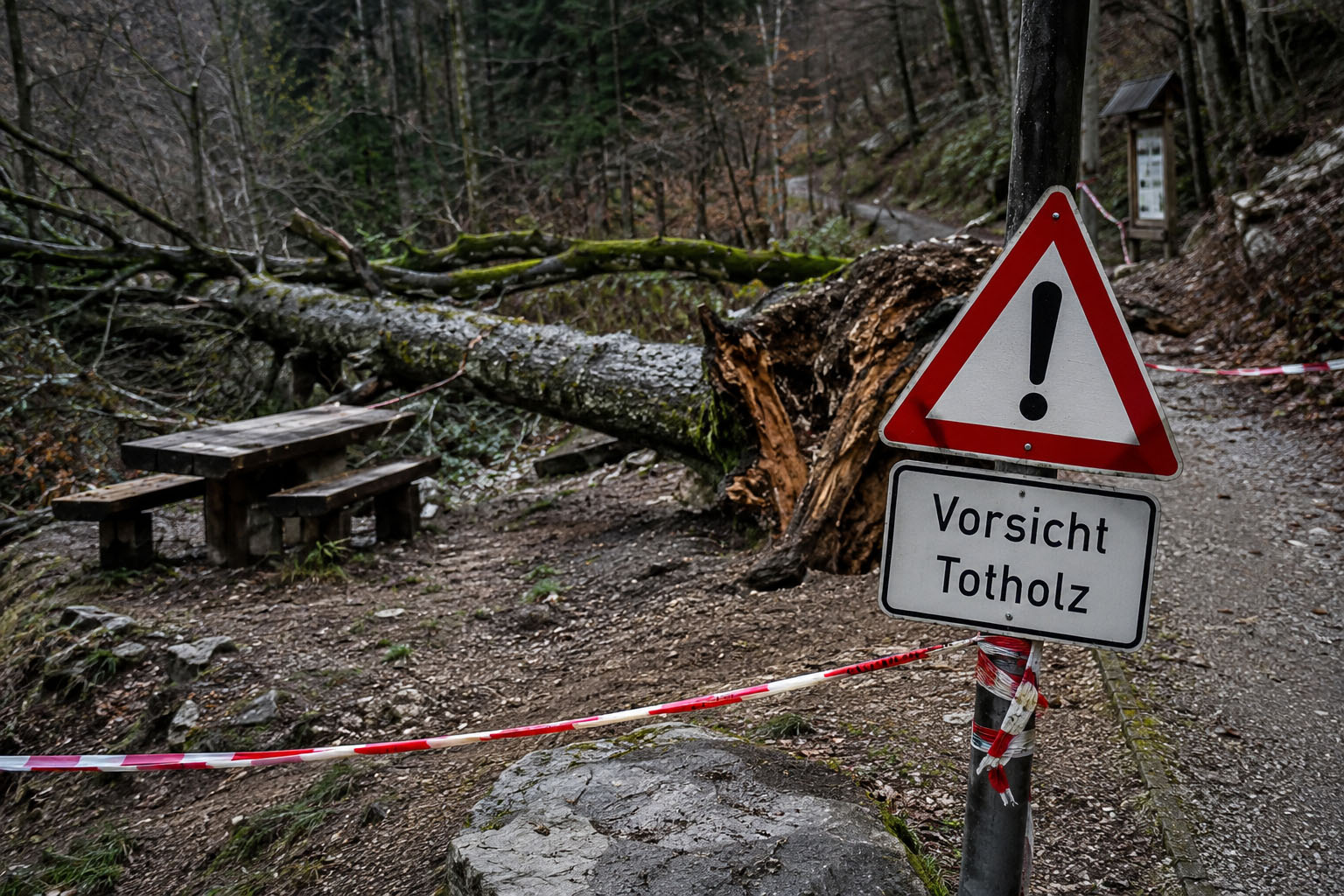
In 2020, a woman out walking in a forested area of the Veveyse district in the canton of Fribourg was struck by a falling tree. The accident left her permanently paraplegic. A lower court initially acquitted the forester responsible for that stretch of woodland, but the injured woman challenged that outcome. The Fribourg Cantonal Court reversed the decision, convicting the forester of negligent grievous bodily harm and sentencing him to a suspended fine of 20 daily penalty units. The court's reasoning struck at the heart of the forestry profession: along a heavily used nature trail, the court held, the forester should have inspected every individual tree or closed the path entirely. That standard has alarmed forestry professionals across Switzerland. Quentin Meyer, head of the La Saubrette forestry cooperative in the canton of Vaud, argues that no forest can ever be made completely safe, and that visitors must accept some personal responsibility when entering a natural environment. Meyer warns that if this ruling sets a precedent, the only realistic response may be to close vast numbers of hiking paths – an outcome he considers both impractical and contrary to Switzerland's tradition of open forest access. He also points to two compounding pressures: trees dying at accelerating rates due to climate change, and a surge in visitor numbers since the COVID-19 pandemic. Discussions are now underway in Vaud to establish clearer risk-management guidelines for forest operators.
Key facts
- In 2020, a tree fell on a hiker in the Veveyse district of Fribourg canton, leaving her paraplegic.
- A lower court initially acquitted the forester responsible for that section of forest.
- The injured woman appealed the acquittal.
- The Fribourg Cantonal Court convicted the forester of negligent grievous bodily harm.
- The sentence is a suspended fine of 20 daily penalty units.
- The court held that the forester should have inspected every tree along the heavily used nature trail or closed the path.
- Forestry professionals fear the ruling creates an unrealistic duty of inspection that could force widespread trail closures.
- Climate change is accelerating tree die-off, increasing the hazard foresters face.
- Forest visitor numbers have risen sharply since the COVID-19 pandemic.
- The canton of Vaud is in discussions to develop clearer forest risk-management guidelines.
The Forest in the Dock
The forester does not sit in the dock like a criminal. He sits there like someone who has spent his entire life counting trees and is now suddenly being counted himself.
In front of him lie files. Behind him lies forest.
The courtroom of the Freiburg cantonal court appears austere. Light wood, bare tables, computer screens. Yet through the open windows shines a summer that looks suspiciously peaceful. One could almost forget why one is sitting here. It is not about a murder, not about a robbery, not about intrigue. It is about a tree.
A single tree.
It had been silent for decades. It had provided shade, shed leaves, carried birds. Then one day it fell over and buried a woman's previous life under its weight.
Since then she has been in a wheelchair.
The tree is silent.
The judges must speak for it.
The injured party gazes calmly ahead. Those who do not know her notice first only the wheelchair. Only later does it become clear that this wheelchair is not the actual verdict—but rather its prehistory.
She had gone for a walk.
Not on a forbidden path. Not during a storm. Not in a night full of thunder.
A summer day.
An educational trail.
A picnic area.
Then the forest crashed down.
Such accidents are usually told with a single sentence: A tree fell.
But between "stood" and "fell" sometimes lie decades—and now several thousand pages of court documents.
The presiding judge speaks matter-of-factly.
"Was the tree recognizably dangerous?"
A simple question.
The forester barely lifts his head.
"A forest does not consist of individual trees."
The sentence hangs in the air.
An expert answers.
"In a place with particularly many visitors, every single tree must be assessed."
Every.
That small word sounds heavier than the trunk of a beech.
The defense paints a picture of a forest that can never be fully controlled.
One cannot manage a forest like a parking lot.
One cannot inspect millions of trees daily.
Nature remains nature.
It ages.
It dies.
It falls.
The prosecution responds equally calmly.
"This was not about just any forest."
It shows aerial photographs.
The picnic area.
The educational trail.
The bench.
Precisely there people linger.
Right there, special care must be taken.
The discussion changes.
Suddenly it is no longer the tree on trial.
Not even the forester.
On trial is the question of how safe nature must be at all.
The forester looks tired.
He knows nothing of headlines.
He knows beetles.
Drought.
Fungal infestation.
Storms.
For years more and more trees have been dying.
Climate change is accelerating what once took decades.
At the same time, more and more people are coming.
Since Corona they seek recreation in the forest.
The forester does not describe his daily work like a civil servant.
He describes it like a man working against time.
"You cannot look at every tree."
The sentence does not sound like an excuse.
More like a surrender.
The judges retire.
One waits.
Nobody speaks.
Only paper rustles.
When the verdict is pronounced, the room hardly changes visibly.
Guilty.
Negligent grievous bodily harm.
Twenty daily rates suspended.
No prison.
And yet no victor leaves the courtroom.
The woman remains paralyzed from the waist down.
The forester remains a forester.
Only his profession has become a different one.
Outside, the trees rustle.
They know nothing of statutes.
They know neither negligence nor duty to ensure public safety.
They grow.
They age.
They die.
And sometimes they fall.
But since this verdict, it is no longer just a tree that falls.
With it falls a decades-long certainty.
That the forest is a place where nature may write its own laws.
Now courts write alongside it.
Whether the final chapter has already been written will not be decided in this courtroom.
That will be determined by the Federal Court.
Until then the forest remains the same.
Only the view of it has changed.
In-depth analysis
On 9 July 2020, two women were taking a break at a picnic table on an official nature trail (sentier didactique) in the forest area of the municipality of Le Flon (district of Veveyse, canton of Fribourg, Switzerland) when a dead beech tree fell and struck one of them, causing complete paraplegia (full spinal cord injury resulting in paralysis from the waist down). The injured woman filed a criminal complaint in September 2020 against persons unknown. Investigations focused on the responsible forest warden (Förster) and, at times, a municipal official. At first instance, the forest warden was acquitted. The injured woman appealed. In July 2026, the Fribourg Cantonal Court overturned the acquittal and convicted the forest warden of negligent serious bodily harm (fahrlässige schwere Körperverletzung). The court found that the tree was dead and rotten and would have been recognisable as dangerous upon careful inspection, given its location directly above a picnic area on an official public trail where visitors were expressly invited to linger. The court concluded the area should have been secured, closed off, or the tree felled. The sentence imposed was 20 day-fines of 180 Swiss francs each, suspended with a two-year probationary period — meaning no imprisonment. The forest warden does not accept the verdict and intends to appeal to the Swiss Federal Supreme Court, supported by the Canton of Fribourg, whose State Councillor Didier Castella publicly stated that holding wardens to an impossible inspection duty is unreasonable given over one million trees in a typical district. The case raises a fundamental legal question about the extent of public safety obligations (Verkehrssicherungspflicht) in forests: must the state make official forest paths and rest areas virtually risk-free, or do visitors assume a degree of natural risk themselves? Media reports have sometimes generalised the ruling as requiring inspection of every tree along every hiking trail, but the court's reasoning appears more narrowly focused on the especially sensitive zone immediately surrounding the picnic area. The outcome at the Federal Supreme Court could set a binding precedent affecting inspection duties, liability exposure for wardens, trail closures, and costs for municipalities and forestry operations across Switzerland — and holds relevance for forest access policy in many other countries.
Timeline
The sequence of events in this case, from what happened to the court's final decision, in the order the court itself laid them out.
9 July 2020
Act
Two women pause at a picnic table on an official nature trail (sentier didactique) in the forest of Le Flon. A dead beech tree falls onto one of them, causing complete paraplegia.
September 2020
Investigation
The injured woman files a criminal complaint against persons unknown. Investigations focus on the responsible forest warden and, at times, a municipal official.
Date not evident in the judgment
Trial (First Instance)
The forest warden is acquitted at first instance.
Date not evident in the judgment
Appeal
The injured woman lodges an appeal against the acquittal.
July 2026
Verdict (Cantonal Court)
The Fribourg Cantonal Court overturns the acquittal and convicts the forest warden of negligent serious bodily harm. Sentence: 20 day-fines of CHF 180, fully suspended with a two-year probationary period.
Pending — date not evident in the judgment
Appeal (Federal Supreme Court)
The forest warden refuses to accept the verdict and plans to bring the case before the Swiss Federal Supreme Court. The Canton of Fribourg supports this further appeal. State Councillor Didier Castella publicly opposes holding wardens to an impossible inspection duty.
Evidence strength
How much weight each piece of evidence carried in the court's own reasoning -- a longer, darker bar means the court leaned on it more heavily in reaching its decision. This reflects the court's stated reasoning, not an independent judgment of the case.
Tree was dead and rotten above a designated public picnic area on an official nature trail
95/100Dangerous condition assessable as recognisable through careful inspection
80/100No safety measures (fencing, closure, felling) implemented by forester for that zone
75/100Severity of injury (complete paraplegia) establishing seriousness of bodily harm
60/100Involved persons
The people named in the judgment and the role each one played -- for example the defendant, a witness, or an expert who testified.
Not evident in the judgment
Defendant / Convicted party · Forest warden (Förster) responsible for the forest area of Le Flon, district of Veveyse, Canton of Fribourg
Not evident in the judgment
Victim / Civil claimant / Appellant · Member of the public using the official nature trail
Not evident in the judgment
Witness / Companion · Second woman present at the picnic area at the time of the incident
Not evident in the judgment
Person of interest during investigation · Municipal official (Gemeindeverantwortlicher)
Didier Castella
Political supporter of further appeal · State Councillor (Staatsrat), Canton of Fribourg
Why the court decided this way
The court's own stated reasons for its ruling, listed in the order the court gave them -- not a ranking of legal importance, just the sequence the judgment presents them in.
- The dead and rotten tree was located immediately above a designated picnic area where visitors were explicitly invited to rest, creating a heightened duty of care for that specific zone
- The court found the tree was visibly dead and decayed, and would have been identifiable as dangerous through careful inspection
- The responsible forester failed to secure, close off, or fell the tree despite its dangerous condition in a high-visitor area
- The court held that the area around the picnic spot constituted a particularly sensitive zone requiring active safety measures, as opposed to a general duty to inspect every tree in the forest
- The location was situated directly alongside an official nature trail, further elevating the foreseeability of public presence and the associated duty of care
Frequently asked questions
What happened in this case?
On 9 July 2020, a woman was sitting at a picnic table on an official nature trail in the forest of Le Flon, canton of Fribourg, Switzerland, when a dead beech tree fell and struck her. She suffered complete paraplegia as a result. She later filed a criminal complaint, and after a first-instance acquittal was overturned on appeal, the responsible forest warden was convicted of negligent serious bodily harm in July 2026.
Who was convicted and of what offence?
The responsible forest warden (Förster) was convicted of negligent serious bodily harm (fahrlässige schwere Körperverletzung) by the Fribourg Cantonal Court in July 2026.
What sentence did the court impose?
The court sentenced the forest warden to 20 day-fines of 180 Swiss francs each, fully suspended with a two-year probationary period. This means no imprisonment was served.
What is a day-fine (Tagessatz) in Swiss criminal law?
A day-fine is a unit of monetary punishment used in Swiss criminal law. The number of units reflects the seriousness of the offence, while the amount per unit is calibrated to the offender's financial means. In this case, 20 day-fines of CHF 180 each were imposed, totalling CHF 3,600, but the sentence was suspended.
What does it mean that the sentence was suspended?
A suspended sentence means the warden does not have to pay the fines provided they comply with conditions — here a two-year probationary period — and commit no further offences. If they breach the conditions, the suspended sentence may be activated.
Why was the forest warden considered responsible?
According to the court's findings, the beech tree was dead and rotten and would have been recognisable as dangerous upon careful inspection. The tree was located directly above a picnic area on an official public trail where visitors were expressly invited to linger. The court concluded the area should have been secured, closed off, or the tree felled.
What was the outcome at first instance?
At first instance, the forest warden was acquitted. The injured woman appealed that acquittal, and the Fribourg Cantonal Court overturned it, resulting in the conviction.
What legal duty was at the centre of this case?
The central legal concept is the Verkehrssicherungspflicht — the duty to ensure public safety in areas open to the public. The case raises the question of how far that duty extends in forested areas, particularly at designated rest spots on official trails.
Does the ruling mean every tree along every hiking trail must be inspected?
Not according to the court's own reasoning as described. Media reports have sometimes generalised the ruling that way, but the court's analysis appears more narrowly focused on the zone immediately surrounding the picnic area — a location where visitors were specifically invited to stop and rest.
Why does the location being a picnic area matter legally?
The court's reasoning suggests that a place where the public is expressly invited to linger creates a heightened duty of care compared to an ordinary path. Visitors at a picnic table are stationary and more exposed to overhead hazards, and the invitation to rest there implies a degree of safety assurance by the managing authority.
Is the case final?
No. The forest warden has indicated an intention to appeal to the Swiss Federal Supreme Court (Bundesgericht), and the Canton of Fribourg has publicly stated its support for that appeal. The case is therefore not final as of the information provided.
Why is the Canton of Fribourg supporting the warden's appeal?
The canton's State Councillor Didier Castella publicly stated that holding wardens to an inspection duty across over one million trees in a typical district is unreasonable and impractical. The canton appears to consider the duty imposed by the conviction to be disproportionate.
What precedent could the Federal Supreme Court set?
A Federal Supreme Court ruling could establish binding national standards on inspection duties for forest wardens, the scope of Verkehrssicherungspflicht on public trails, liability exposure for municipalities and cantons, and whether visitors to natural areas assume a degree of inherent risk. It could also influence policy on trail closures and forestry management costs across Switzerland.
Could this case have implications outside Switzerland?
The case is noted as holding relevance for forest access policy in many other countries, given that the tension between public safety obligations and the natural character of forests is a common issue in jurisdictions that manage public woodland trails.
What injury did the victim suffer?
The victim suffered complete paraplegia — a full spinal cord injury resulting in paralysis from the waist down — when the dead beech tree fell and struck her.
How did the criminal proceedings begin?
The injured woman filed a criminal complaint in September 2020 against persons unknown. Investigations subsequently focused on the forest warden and, at times, a municipal official.
Was any municipal official ultimately charged or convicted?
The summary indicates that a municipal official was at times a focus of the investigation, but the conviction described is solely that of the forest warden. No conviction of a municipal official is mentioned in the judgment summary.
What type of tree caused the injury, and why does that matter?
The tree was a dead beech (Rotbuche). The court found it was rotten and that its dangerous condition would have been recognisable upon careful inspection. The species is relevant because dead beech trees are known in forestry to lose structural integrity relatively quickly, which bears on the foreseeability of the hazard.
What is the broader policy debate this case has triggered?
The case raises a fundamental question about whether the state must make official forest paths and rest areas virtually risk-free, or whether visitors to natural environments accept a degree of inherent natural risk. The outcome will affect how Swiss authorities balance public access to forests against safety obligations and the practical and financial costs of compliance.
Where exactly did the accident occur?
The accident occurred on an official nature trail (sentier didactique) in the forest area of the municipality of Le Flon, in the district of Veveyse, canton of Fribourg, Switzerland.
What practical steps does the court appear to have expected the warden to take?
Based on the court's findings, the expected measures were securing the area, closing it off to the public, or felling the dead and rotten tree — particularly given its position directly above a picnic area on an official trail where visitors were invited to linger.
Could the warden face civil liability in addition to the criminal conviction?
The judgment summary addresses only the criminal proceedings. Whether civil proceedings for damages have been or will be brought is not evident in the judgment as summarised.
Why it matters
The ruling raises the standard of care expected of foresters to a level that critics argue is unachievable in practice, potentially setting a precedent that could force the closure of public hiking paths across Switzerland. It brings into sharp focus the tension between the right to open forest access and the legal liability that comes when accidents occur in uncontrollable natural environments. The case is prompting Switzerland's forestry sector to push for clearer statutory guidelines on what constitutes adequate risk management.
Sources
Share of negligent offences in Switzerland
Where do most accidents happen in Switzerland?
After the Verdict – Reflections
People always ask how a verdict could have been prevented. The same question is asked of a roof after it has collapsed, of a ship after it has sunk, or of a person after their heart has stopped beating. Rarely does anyone ask it beforehand.
The forester might have been able to examine every tree. He might have tapped every trunk with a small hammer, scrutinized every crown through binoculars, had every rotten branch felled. Then perhaps this tree would not have fallen.
But perhaps another one would have.
Because the forest is not a clockwork mechanism. It is older than all statutes and will outlive them.
One asks how the forester could have reduced his punishment.
Perhaps he should have wept.
Courts do not love tears, but they do not distrust them either. A man who says: "I did everything correctly" sometimes insults the victim's pain, even though he speaks the truth. But a man who says: "I will never forget this woman" does not speak about guilt, but about humanity. And sometimes humanity weighs more in court than logic.
One questions his lawyer.
The lawyer defended the forester.
Perhaps he should have defended the human being.
He spoke of forest management, of professional guidelines, of natural hazards, of dead beeches and duty to ensure public safety. Everything was right. Everything was reasonable.
Only one thing was missing.
The woman.
In court, one must never forget that at the beginning of every file stands a human being. Judges rule according to laws. But they listen to stories first.
Perhaps the defense should have said:
"My client meant this woman no harm. He will carry the day of her misfortune with him for the rest of his life. He does not ask the court for pity. He only asks not to be held almighty. He became a forester because he loves trees. Not because he rules over them."
Perhaps this sentence would have changed nothing.
Perhaps everything.
And finally one asks about the judge.
Was he strict?
Was he unjust?
Was he driven by the spirit of the times?
No.
He was a judge.
Judges rarely judge only about the person before them. They always judge also for those who come tomorrow.
Fifty years ago, perhaps the tree would have been guilty.
Today one looks for the responsible party.
Tomorrow perhaps one will ask the legislator.
Thus guilt wanders through time like a lonely wanderer through the forest.
And the forester?
He will walk among the beeches again.
But from now on, every dead branch he hears crack above him will no longer sound merely of wood.
It will sound like a verdict.