Nusikalstamumas · Austrija · Landesgericht Feldkirch (Feldkirch Regional Court)
"I'm Not Your Brother": Judge Rebukes 'Bro' Remark as Alleged Robbery Case Ends in Acquittals
A robbery trial in Feldkirch, Austria, unraveled spectacularly when the alleged victim changed his story on the stand and dismissed the judge's scepticism with a breezy 'All good, bro' — prompting the visibly irritated judge to snap back: 'I am not your brother!'
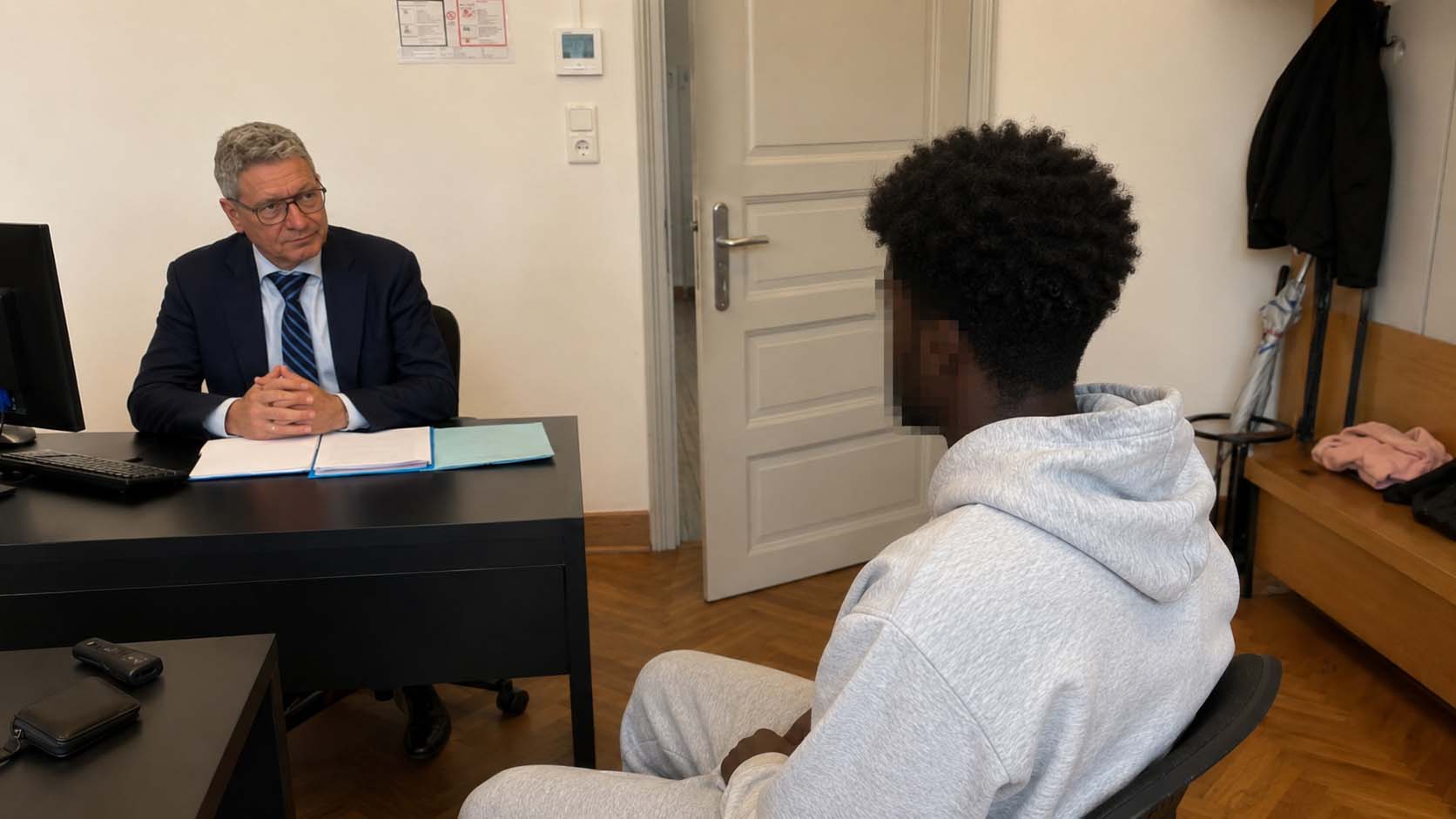
'Bro': The Feldkirch Regional Court as a theater stage.
It started as a straightforward robbery case: two Somali men were accused of luring a man from a betting shop in Dornbirn into a dark alleyway in late January, on the pretext of changing money, then taking a 100-euro note from him by force. Security footage confirmed the three men left the venue together that night, but the actual alleged assault happened off camera — and from there, the case fell apart piece by piece. The defendants offered a starkly different account, claiming the encounter was nothing more than a small cannabis deal worth 20 euros, with the alleged victim owing money. Then the alleged victim himself took the stand and promptly contradicted his own police statement, suddenly insisting the second defendant was actually a friend who had stepped in to mediate. Judge Elias Klingseis confronted him directly with the contradictions, making clear he wasn't buying the story — only for the witness to shrug it off with 'All good, bro.' The judge, visibly annoyed, cut him off: 'I am not your brother.' Even the prosecutor conceded the witness had 'certainly not told the whole truth,' though she noted that was hardly unusual in drug-related matters. With the robbery charge unsustainable, both defendants were acquitted. However, the first defendant — who had prior convictions — was separately found guilty of unlawful possession of narcotics, fined 600 euros, and had the probation period of an earlier suspended sentence extended to five years. Both verdicts are final.
Pagrindiniai faktai
- Two Somali men were charged with robberly theft allegedly committed in late January in Dornbirn, Austria.
- The alleged victim's account changed significantly between his police statement and his court testimony.
- The defendants claimed the encounter was a 20-euro cannabis deal, not a robbery.
- Security footage showed the three men leaving the betting shop together but did not capture the alleged offence.
- The witness addressed Judge Klingseis as 'Bro,' prompting a sharp rebuke from the bench.
- The prosecutor acknowledged the witness had likely not told the full truth.
- Both defendants were acquitted of the robbery charge.
- The first defendant was convicted of unlawful drug possession and fined 600 euros.
- The first defendant's probation period from a prior suspended sentence was extended to five years.
- All verdicts are legally final.
The Man Who Called the Judge 'Bro'
There are court proceedings in which the verdict seems to vanish long before the judge's ruling. Not because the law has failed, but because the truth has changed its clothes along the way and finally appears in a form that no one recognizes anymore.
In Feldkirch, two men stood before the court. The prosecution told of a nighttime robbery: a betting parlor, a hundred-euro note, a dark side alley, and violence. It was a story the way files love them – straightforward, orderly, with a clear beginning. Yet stories that work on paper sometimes lose their footing outside the files.
The surveillance cameras proved to be conscientious witnesses. They saw three men leaving a bar together. Nothing more. Cameras observe movements, not intentions. They know paths, but not motives. Precisely where criminal law begins, their language often ends.
The defendants told a different story. No robbery, they said. Just a failed deal over some cannabis worth barely twenty euros. A small dispute among men who met one night and wanted nothing to do with each other by morning.
The most important witness seemed to know every version – except his own. What had been true yesterday suddenly looked different today. A burdened witness became almost a friend. A co-defendant became a mediator. The sentences changed direction with an ease that left the judge bewildered.
Finally, the presiding judge laid down reason's last card on the table.
'This story, I don't buy it.'
The witness smiled as if he were not in a courtroom but on a street corner.
'All good, Bro.'
It was just a single word. Short enough to be overlooked, yet long enough to make visible the distance between court and street. The judge replied coldly:
'I am not your brother.'
Perhaps there was more in that sentence about our time than in the many pages of investigative files. The court demands distance, language, and accountability. Everyday life increasingly answers with familiarity, slang, and indifference.
In the end, not enough remained of the grand accusation of armed theft. Doubt in criminal law is not a weakness but a protection. Where facts can no longer be distinguished from narratives, no conviction may stand. Both defendants were therefore acquitted.
Only one secondary matter remained. One of the men was convicted of illegal drug possession and sentenced to a fine. The grand proceeding shrank into a small offense – like a thunderstorm that in the end leaves only a few raindrops behind.
Those who left the courtroom probably didn't take the legal niceties home with them. What remained in memory was that brief exchange between a judge who insisted on dignity and a witness who wanted to bridge formality with a casual 'Bro.' Sometimes a single word tells more about an era than an entire trial.
Išsami analizė
Tik anglų kalbaTwo Somali nationals were tried at the Regional Court of Feldkirch, Austria, on charges of aggravated robbery (räuberischer Diebstahl). They were accused of luring a man out of a betting shop in Dornbirn into a dark alleyway under the pretext of exchanging money, then taking a 100-euro banknote from him by force in late January. Both defendants completely denied the robbery, instead claiming the encounter involved only a small cannabis transaction worth 20 euros and that the alleged victim still owed them money. The case hinged almost entirely on the testimony of the alleged victim, as the only available video footage confirmed merely that the three men left the betting shop together — the alleged assault itself was not captured on any recording. The key witness severely undermined his own credibility by contradicting his earlier police statements at trial, most notably by suddenly claiming to be friends with the second defendant and stating that this defendant had actually acted as a mediator — a claim directly at odds with his prior statement to police, in which he had identified the second defendant as a primary perpetrator. Judge Elias Klingseis explicitly stated he did not believe the witness's revised account. The hearing also featured a notable courtroom exchange: when the judge told the witness 'I don't buy that story,' the witness replied 'All good, Bro,' prompting the judge to respond sharply, 'I am not your brother!' This moment became the most memorable episode of the proceedings. Applying the principle of in dubio pro reo (when in doubt, in favour of the accused), the court acquitted both defendants of the robbery charge, not because it was convinced of their innocence, but because the evidence did not meet the required standard of proof. The objective evidence was insufficient, and the sole incriminating witness was found to be not credible. However, the first defendant, who had relevant prior convictions, faced an expanded charge: he was convicted of unlawful possession of narcotics, fined 600 euros, and had a previously imposed probationary period extended to five years. All verdicts are legally final.
Laiko juosta
Įvykių seka šioje byloje, nuo to, kas nutiko, iki galutinio teismo sprendimo, tokia tvarka, kaip juos išdėstė pats teismas.
End of January (exact date not specified)
Act
Alleged robbery: the victim was reportedly lured from a betting shop in Dornbirn into a dark alleyway under the pretext of exchanging money, and a 100-euro note was allegedly taken from him by force.
Date unknown
Investigation
Police investigation conducted. The alleged victim gave a statement to police, primarily implicating the second defendant as the main perpetrator. Video footage from the area was reviewed, confirming only that the three men left the betting shop together.
Date unknown
Indictment
Both defendants charged with aggravated robbery (räuberischer Diebstahl). The charge against Defendant 1 was later expanded to include unlawful possession of narcotics.
Date unknown
Trial
Trial held at Landesgericht Feldkirch before Judge Elias Klingseis. Both defendants denied the robbery entirely, claiming the interaction was a 20-euro cannabis deal and that the victim still owed them money. The key witness contradicted his police statement, claiming to be friends with Defendant 2 and stating Defendant 2 had acted as a mediator. The judge stated he did not believe the witness's revised account. The notable 'Bro' exchange occurred between the judge and the witness.
Date unknown
Verdict
Both defendants acquitted of aggravated robbery due to insufficient evidence and the unreliability of the key witness. Defendant 1 convicted of unlawful narcotics possession, fined 600 euros, and had his probationary period extended to five years. All verdicts are legally final.
Įrodymų svoris
Kiek svorio kiekvienas įrodymas turėjo paties teismo argumentacijoje - ilgesnė, tamsesnė juosta reiškia, kad teismas juo labiau rėmėsi priimdamas sprendimą. Tai atspindi teismo nurodytą argumentaciją, o ne nepriklausomą bylos vertinimą.
Contradictory witness testimony of alleged victim
15/100Video footage (shows joint departure from betting shop only)
30/100Defendants' consistent denial and alternative account (cannabis deal)
40/100Absence of physical or forensic evidence of violence
10/100First defendant's prior criminal record (relevant only to narcotics charge)
5/100Susiję asmenys
Sprendime įvardyti asmenys ir kiekvieno jų vaidmuo - pavyzdžiui, kaltinamasis, liudytojas ar ekspertas, kuris davė parodymus.
Defendant 1 (First Accused)
Defendant · Somali national accused of aggravated robbery alongside Defendant 2.
Defendant 2 (Second Accused)
Defendant · Somali national accused of aggravated robbery alongside Defendant 1.
Alleged Victim (Key Witness)
Complainant / Primary prosecution witness · The man allegedly robbed in the alleyway; the sole direct witness to the alleged assault.
Judge Elias Klingseis
Presiding Judge · Judge at Landesgericht Feldkirch; presided over the trial and delivered the verdict.
Kodėl teismas taip nusprendė
Paties teismo nurodytos sprendimo priežastys, išvardytos ta tvarka, kokia jas pateikė teismas - tai ne teisinės svarbos reitingas, o tiesiog seka, kokia jos pateikiamos sprendime.
- The sole prosecution witness (the alleged victim) contradicted his own earlier statements multiple times, rendering his testimony substantially incredible to the court
- No objective evidence of a violent theft existed: video footage only confirmed the three men left the betting shop together, not any assault or robbery
- The reasonable doubt standard ('in dubio pro reo') could not be satisfied given the contradictory and unreliable witness testimony and absence of corroborating evidence
- Both defendants consistently denied the robbery and offered an alternative explanation (a cannabis transaction of 20 euros with an outstanding debt), which could not be conclusively disproven
- The witness's in-court revision — claiming friendship with the second defendant and that the second defendant had even mediated — directly contradicted his police statement, further undermining the prosecution case
Dažnai užduodami klausimai
What were the main charges in this case?
The two defendants were charged with räuberischer Diebstahl (aggravated robbery). The first defendant additionally faced a charge of unerlaubter Besitz von Suchtgift (unlawful possession of narcotics).
What was the outcome of the robbery charge for both defendants?
Both defendants were acquitted of the aggravated robbery charge. The court found that the evidence did not meet the required standard of proof.
What legal principle did the court apply to reach the acquittal?
The court applied the principle of in dubio pro reo, meaning 'when in doubt, in favour of the accused.' The acquittal was not based on a finding of innocence but on the insufficiency of the evidence.
Did the court believe the defendants were innocent of the robbery?
Not necessarily. The court explicitly did not convict because the evidence standard was not met, not because it was affirmatively convinced of the defendants' innocence.
What did the defendants say happened during the encounter?
The defendants denied the robbery entirely. They claimed the encounter involved only a small cannabis transaction worth 20 euros and stated that the alleged victim still owed them money.
What did the alleged victim claim happened?
The alleged victim claimed he was lured from a betting shop in Dornbirn into a dark alleyway under the pretext of a money exchange, and that the defendants then took a 100-euro banknote from him by force.
Why was the key witness found to be not credible?
The witness severely contradicted his earlier police statement at trial. Most notably, he suddenly claimed to be friends with the second defendant and said that defendant had acted as a mediator — directly contradicting his prior statement to police in which he had identified that same defendant as a primary perpetrator.
What did the judge say about the witness's revised account?
Judge Elias Klingseis explicitly stated that he did not believe the witness's revised account.
Was there any video evidence in this case?
Yes, but it was limited. Available video footage confirmed only that the three men left the betting shop together. The alleged assault itself was not captured on any recording.
What was the memorable courtroom exchange between the judge and the witness?
When the judge told the witness 'I don't buy that story,' the witness replied 'All good, Bro.' The judge then responded sharply, 'I am not your brother!'
What happened to the first defendant beyond the robbery charge?
The first defendant was convicted of unlawful possession of narcotics, fined 600 euros, and had a previously imposed probationary period extended to five years.
Was the second defendant convicted of anything?
Not evident in the judgment beyond the acquittal on the robbery charge. No ancillary conviction is mentioned for the second defendant.
Why did the first defendant face an expanded charge compared to the second defendant?
The first defendant had relevant prior convictions, which supported the additional narcotics possession charge and the extension of his probationary period.
Where did the alleged robbery take place?
The alleged robbery took place in Dornbirn, Austria, in a dark alleyway near a betting shop, in late January.
Which court heard this case?
The case was heard at the Regional Court of Feldkirch, Austria.
Who was the presiding judge?
The presiding judge was Judge Elias Klingseis.
Are the verdicts subject to appeal?
The judgment states that all verdicts are legally final.
What was the alleged value of the item taken in the robbery?
The alleged victim claimed a 100-euro banknote was taken from him by force.
What was the alleged value of the cannabis transaction according to the defendants?
The defendants claimed the transaction involved cannabis worth 20 euros.
How many witnesses were available to support the robbery charge?
The case hinged almost entirely on the testimony of the alleged victim, who was the sole incriminating witness. No other witnesses corroborating the robbery are mentioned in the judgment.
What is räuberischer Diebstahl under Austrian law?
The judgment characterizes räuberischer Diebstahl as aggravated robbery. Beyond this characterization in the case summary, further statutory detail is not evident in the judgment.
Did the defendants' nationality play any stated role in the court's reasoning?
Not evident in the judgment. The defendants' Somali nationality is noted as background context but no role in the court's legal reasoning is described.
Kodėl tai svarbu
The case illustrates how a robbery prosecution can collapse entirely when the key witness contradicts his own prior statements, leaving the court unable to establish the facts beyond reasonable doubt. It also highlights how drug-related encounters can generate conflicting narratives that frustrate truth-finding, and how courts may still pursue ancillary charges — here, drug possession — when the primary charge fails.
Šaltiniai
Austrian Reconviction Rate
Context: The Price of Doubt
A court is not a theater. And yet there are days when the stage is better cast than the play.
One might shake one's head at the effort. Police, prosecutors, judges, defense attorneys, interpreters, court clerks – an entire state apparatus set itself in motion over alleged damages of one hundred euros, or perhaps just over a failed cannabis deal worth twenty euros. Ask the taxpayer, and they will see waste. Ask the rule of law, and you get a different answer: it is not the amount of money that determines whether criminal proceedings are conducted, but the suspicion of a serious crime.
And serious the accusation certainly was. Armed theft is among those offenses where property and violence intersect. Had the court been convinced by the prosecution, the defendants would have faced not a minor offense, but a painful prison sentence. What began as a nighttime walk from a betting parlor into a side alley could easily have become the start of a long imprisonment.
But between suspicion and conviction lies the burden of proof. For a guilty verdict, the court would have had to be convinced that the accusation actually occurred as the prosecution described it. It would have needed credible, internally consistent testimony or objective evidence that mutually supported each other. That is precisely where the case failed. The main witness contradicted himself, the video recordings ended where the decisive minutes began, and the defendants' alternative explanation could neither be reliably refuted nor confirmed. Criminal law knows only one answer to such situations: in case of doubt, no conviction may stand.
Some may find this outcome unsatisfying. Yet an acquittal does not necessarily mean that nothing happened. It merely means that what happened could not be proven with the required certainty. This distinction is uncomfortable – but it protects every citizen from convictions based on mere suspicion.
The question remains whether the defendants learned anything from this proceeding. No court has an answer to that. At least one of them was convicted of illegal drug possession and already had a prior conviction for the same offense. This shows that this was not his first conflict with the law. Whether he will distance himself from criminal activity in the future or appear in court again, no one can seriously predict. Recidivism statistics describe probabilities, but never the fate of a single person.
Perhaps the real lesson of this trial is something else. Not the casual shout of 'Bro,' which drew attention for a brief moment, remains significant. What matters is that a state under the rule of law is prepared to treat even a small, tangled, and unpleasant-seeming case with the same care as a major one. For the weight of justice is not measured by the value of the banknote, but by the thoroughness with which it seeks the truth.